The Path from Victimhood to Sovereignty
The Reclamation of Empowerment
There is an awareness that sometimes presents in the small hours of the morning: life feels as though it is happening to you. Circumstances seem to be authored by forces beyond control. Bad luck, other people, history, circumstances, the past — these are the architects of a life one did not choose and cannot change. “It’s not my fault,” is the motto of this mindset.
This is victim consciousness. It is the condition that results from relinquishing personal authority and losing sight of self-determination or will. Victim consciousness declares that there was never a chance, the proverbial ‘they’ have always been out to sabotage any possible success.
Seeing the Pattern
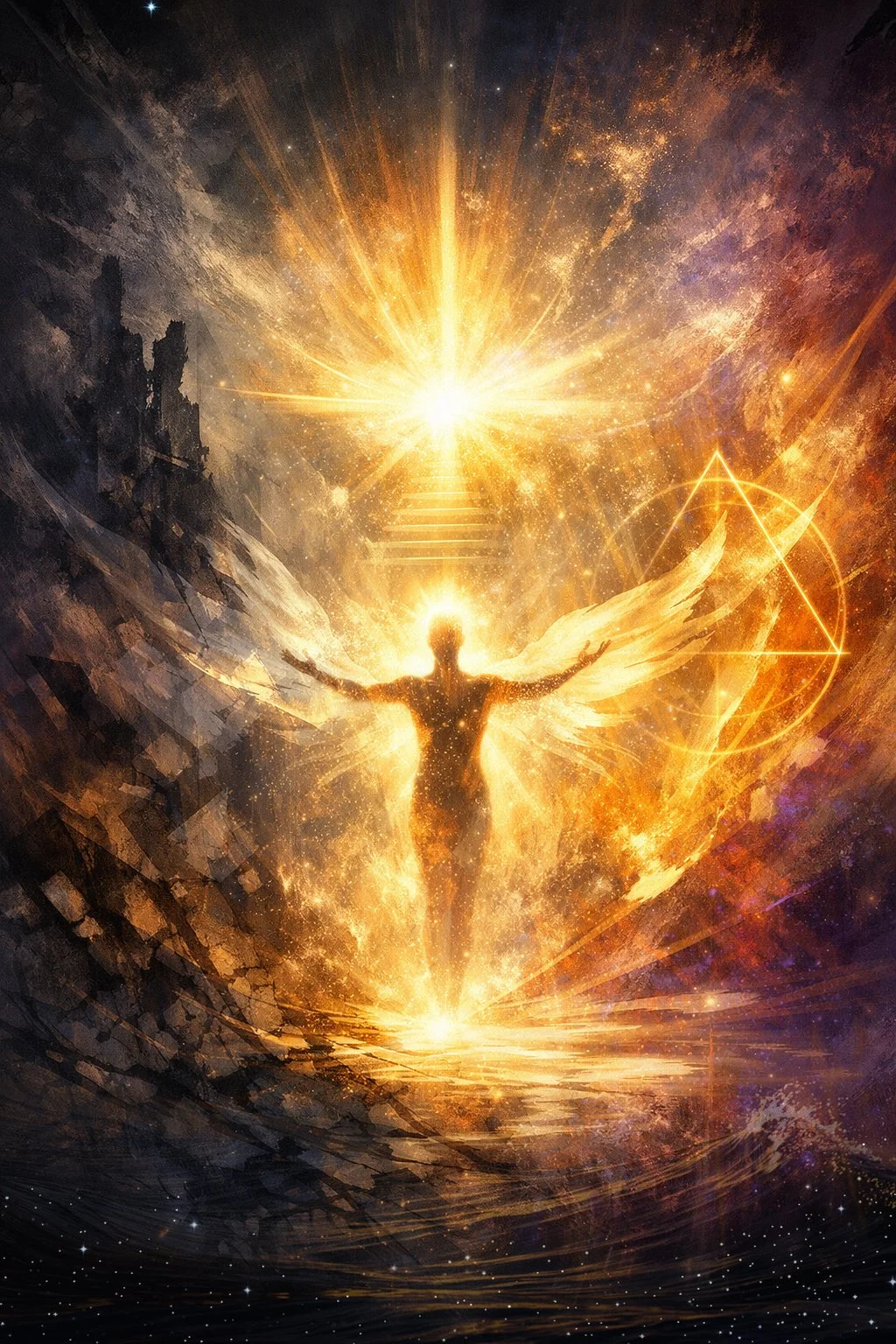
Any journey out of victimhood begins not with a defined action, but with witnessing. A moment — sometimes quiet, sometimes shattering — in which the ego steps back far enough to observe its own patterns. At some point, self-awareness declares I have been here before. This keeps happening. I keep choosing this. Something in me is creating this. That must mean I can make a different choice. That is the progression needed to extricate the poor victim from the self-created abyss of helplessness and propel them toward a more self-determined life.
This is not to be confused with self-blame. This is the birth of the observer — the part of consciousness that can hold the lesson of the experience without being emotionally consumed by it. It is the first flicker of sovereignty: the recognition that identity and circumstance, however entangled they appear, are not the same thing.
From this place of witnessing, a more revealing question becomes possible: What if I am not a victim in this life, but its architect and visionary artist?
Radical Responsibility as Sacred Act
To accept absolute responsibility for one’s experience is, in modern culture, often confused with self-recrimination. It is not. Any form of self-blame is still victim consciousness — it simply relocates the persecutor from outside to inside.
Radical responsibility is something altogether different. It is the recognition that the self is not a passenger in this reality, but an inherent part in its construction. That attention, belief, unhealed wound, and unconscious fear all reach outward into the world and draw back what resonates. This is not magical thinking — it is the experience of anyone who has done genuine inner work.
To say, “I chose this,” is not to diminish the pain and suffering. It is to restore agency to the one who suffered. It is the moment the prisoner realizes they have been holding the key all along.
And yet — even here — something must die before that key can be used to open the holding cell of passive victim and step into the unlimited potential of active intender.
The Dark Night: The Shaman’s Death
In the great mystical traditions, in the initiatory rites of shamanic cultures, in the alchemical texts of medieval Europe, there is a universal recognition: transformation is not renovation. You cannot simply redecorate the old self. Something must be broken open. Something must be unmade. The tower must fall in order to be rebuilt from the foundation.
The alchemist called it nigredo — the blackening, the putrefaction, the stage in which base matter is reduced to undifferentiated prima materia before gold can be born. The shaman called it death and dismemberment — the initiate torn apart by spirits in the lower world, then reassembled with new eyes. The mystic traditions called it the Dark Night of the Soul — the withdrawal of all consolation, the collapse of every familiar structure, the seeming absence of divine Source, precisely at the moment one most needs presence. In the modern psychology of Jungian terms, it is referred to as the Shadow Self.
These are not metaphors. They describe a genuine dissolution of ego or self-identity.
The threshold between victim and sovereign is precisely this: a death. The death of the story that life is something that happens to me. And like all deaths, it cannot be managed, scheduled, or made comfortable. It can only be entered, endured, and — if one does not flee — passed through.
What makes this passage alchemical rather than merely destructive is the quality of attention brought to it. The one who flees the dark night returns, eventually, to the same threshold, again and again. The one who enters it consciously — who chooses to remain present in the dissolution, to ask what is being stripped away and why — discovers that what is dying is not the self, but the false self. The identity built from ancestral wounds, from adaptation, from every moment the authentic nature was set aside in favor of survival or acceptance.
The wound, in this light, is not an obstacle to transformation. It is the portal.
Power Remembered, Not Seized
What emerges from the dark night is not an upgraded version of the old self. It is something quieter, and deeper — more self-aware and capable.
The reclaimed self does not grasp for power — it remembers. There is a crucial distinction. Grasping suggests the power was elsewhere and must be taken from something or someone. Remembering suggests it was never absent — only forgotten, buried under the accumulated weight of a deferred responsibility.
This is Sovereign Consciousness: not dominion over others, but the unshakeable recognition that one is the origin and source of one’s own experience. That perception is always available. That intention is always possible. The Sovereign Self, at its deepest level, is not a victim of circumstance but the creator of experience.
From this place, even challenges have a different texture. Obstacles become information. Relationships become mirrors. The same world that once felt like a prison is revealed to be a canvas.
The Divine Self: The Oldest Teaching
Every major wisdom tradition has pointed toward the same destination in different language.
Atman is Brahman — the individual self is identical with the universal ground of being. The Kingdom of Heaven is within you. The Sufi poet’s cry that the Beloved was never elsewhere. The Buddhist recognition of Buddha-nature as the inherent, uncontaminated nature of every mind.
What each of these teachings holds is this: the self that has been contracted into victimhood, and the self that breaks open in the dark night, and the self that emerges into sovereignty — these are all expressions of one thing. A Divine intelligence, vast and creative and fundamentally free, temporarily wearing the costume of a human life.
Accepting unconditional responsibility is the final act of this newfound comprehension. Not because one caused everything in some punitive sense — but because the self that would deny responsibility is the same self that believes it is separate from the whole. To say I am the author of this is, in its deepest reading, to say I am not separate from reality. I am reality, knowing itself through this unique form. The ocean individuating as a wave in order to experience the shoreline.
The Invitation
The path from victim to sovereign is not linear. It moves in a spiral. One can pass through the dark night and return, months or years later, to another layer of contraction, another threshold, another death. This is not failure — it is the nature of growth.
What changes, over time, is the relationship to the process itself. The one who has passed through once knows the territory. They recognize the dark night not as desolation but as initiation. They know that dissolution is part of preparation. They have learned, at the level of the body and the soul, that they are not destroyed by what they are willing to release. They are able to surrender the powerless perspective of victim and claim personal sovereignty as co-creator.
And in that moment — in that hard-won, bone-deep trust in the process of transformation — the sovereign self is discovered.