The Sentience of Trees
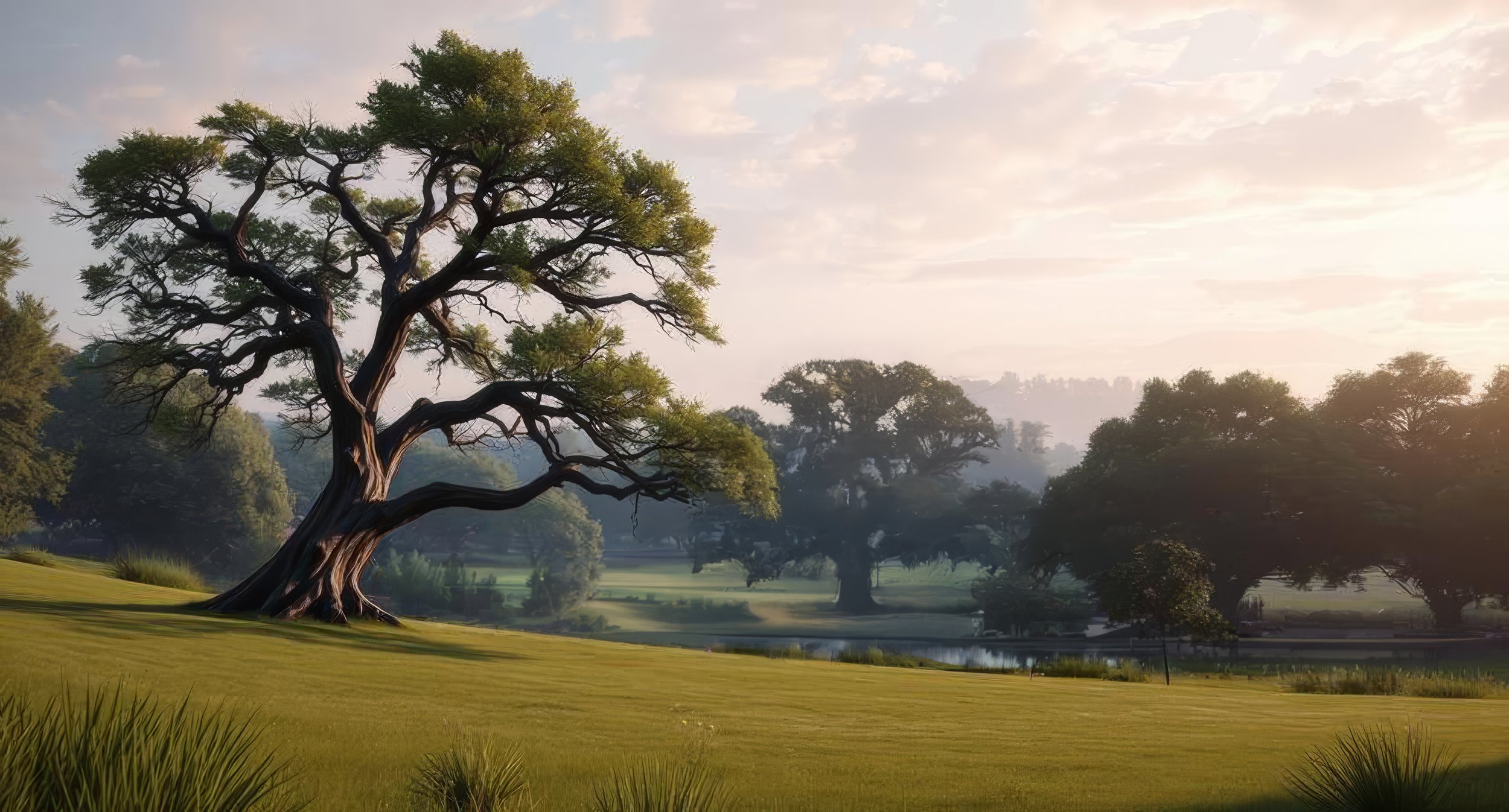
I spent a moment in a memory this morning. A day when I was grieving the loss of a beloved grove of trees. This is the result of that musing.
I'd like to dedicate it to Brenda Bernal Negley who knows the grove I was grieving and to Kathleen and Breighton Dawe who shared its whispering with me...
…and to those who listen...
The Sentience of Trees
For those who have listened to the trees
I. What does it mean to feel?
Philosophy has long drawn a line between two modes of inner life: sentience — the raw capacity to feel, to experience, to register the world from the inside — and cognizance — the capacity to know, to process, to represent. We tend to assume these belong together, arriving as a package in creatures complex enough to warrant our attention. But what if they are far more widely distributed than we have ever dared to consider?
The question of sentience is not merely academic. It asks us to reckon with who else is here. Who else is experiencing this world alongside us, in registers we have not yet learned to read.
At the heart of sentience, most rigorously defined, lies a single irreducible feature: the awareness of self against not-self. Not intelligence. Not language. Not even nervous tissue. Simply the living knowledge — however dim, however distributed — that there is a here, and a there. A me, and a world that is not me, and yet it is the context within which I experience me.
❖
II. Memory encoded in mycelium
Beneath every ancient forest lies a second forest — invisible, vast, and perhaps more alive than the trees it connects. The mycorrhizal network, threaded through soil across thousands of acres, binds root to root in a web of chemical exchange so sophisticated that scientists have begun calling it, without entirely meaning it as metaphor, a nervous system.
Ecologist Suzanne Simard’s decades of field research demonstrated that trees actively transfer carbon, water, and chemical signals through fungal networks — and that older “mother trees” preferentially nurture younger kin. Most striking: when a mother tree is dying, the rate of transfer increases. Something in the system behaves as though it knows what is coming, and acts accordingly.
The mycelium is not merely a conduit. It is among the oldest living organisms on Earth, capable of solving spatial problems, optimizing nutrient pathways, and encoding what can only be called chemical memory across centuries of contact with the forest above. It has witnessed everything. It has held everything.
Which means the trunk — the part we see, the part that burns — may be the least essential part of what a tree actually is. An expression upward into light. The primary body has always been below, in the dark, threaded through the earth in every direction, joined to every neighbor it has ever known.
The fire did not reach what mattered most. Because what mattered most was never where the fire was.
❖
III. Information sent through roots as the trunks burned
There are accounts — arriving not through laboratory instruments but through the older technology of direct perception — of something extraordinary occurring in forests under threat. As fire takes the visible body of a tree, something moves through the roots. Not in desperation. Not in the frantic logic of last-minute preservation. But with the calm precision of a system that has always known where its essential self resides.
The information that constitutes a forest — its accumulated chemical knowledge, its encoded relationships, its memory of seasons and storms and the particular quality of light through its canopy in a dry October — does not live in the wood. It lives in the network. And the network, below the reach of flame, receives it.
Nothing vital is lost. The forest simply draws itself inward, holds itself in the root consciousness, and waits. The younger trees, nourished suddenly by the released resources of their elders, grow faster. The mycelium holds the memory. What appears as destruction from above is, from below, a continuation — even, perhaps, a kind of transmission.
❖
IV. Partners in whatever state their bark may be in
Consider two ancient trees, grown beside each other for centuries. Their roots long since intertwined beyond the possibility of separation. Their canopies shaped by each other’s presence. Their entire chemical identity formed in constant relation to one another.
When one falls — to storm, to age, to the inevitable consequence of entropy — what has actually changed? The bark has changed. The orientation has changed. But the connection remains. The mycelium thread between them remains. Whatever passed between them in a century of adjacency has not been lost.
The standing tree, if it experiences such things — and the evidence suggests increasingly that it does — does not experience the fallen one as absent. It experiences it as simply changed. Still present in the earth. Still joined at the level that was always the primary level of their joining.
We are still together and will be forever, in whatever state our bark may be in. Our energy is joined in the earth and sky.
A FELT TRANSMISSION — ANCIENT REDWOOD FOREST, NORTHERN CALIFORNIA
This is not consolation. It is not the forest being kind to a grieving human observer. It is the forest describing its own actual ontology — a reality in which the boundaries we consider fundamental simply are not boundaries at all, viewed from sufficient scope — which includes both height and depth. A consciousness that holds the whole.
❖
V. A consciousness that holds boundaries lightly
If we return to the question of sentience — the self/not-self awareness at its root — the forest presents us with something that confounds our usual categories. The individual tree knows itself as distinct. It maintains a boundary, interfaces with the world, responds to its particular location and conditions. Self-hood, at the individual scale, is present.
And yet at the collective scale, that boundary has dissolved. The tree does not experience its neighbor as other. It does not experience the fallen as gone. It operates simultaneously at two levels of selfhood: the individual and the collective, holding both without contradiction or separation.
This is, if we attend to it carefully, a more sophisticated relationship with selfhood than humans usually manage. We are deeply boundaried. We experience separation as fundamental and absolute. We grieve as though ending were real. The forest, it seems, has resolved something we are still working through — using boundaries as needed, releasing them when not, living with full fluency in both modes.
The indigenous traditions that spoke of forest consciousness, of the intelligence of trees, of the web of life as a sentient whole — they were not being metaphorical. They were expressing, in the language available to them through centuries of knowing, the truth that mycologists and plant neurobiologists are just now beginning to map in the language available to us now.
❖
The trees were never dead.
Their sacredness was never in the trunks. Their love was never in the bark. Their being was always in the connection — the ancient, patient, underground web of relationship that embodies everything essential and releases only that which no longer serves the unified wholeness.
We come to forests with our human grief and our human categories of ending. And sometimes, if we come with enough stillness and enough sincerity, something very old offers us a quiet understanding.
Not comfort. Something better than comfort. A different way of seeing — one in which loss is real, but ending is not. In which separation may be felt, but it is never the deepest truth. In which what matters most has always been held safely below, in the dark, in the mycelium, waiting.
❖
With love for those who have listened to the trees…
D'Elle Milton